

GBP/USD retreated slightly on Tuesday after a positive Monday, moving down to 1.3486. The market continues to assess the economic data released late last week. The US dollar has so far drawn support from lingering uncertainty in the Middle East, which has encouraged investor caution and supported demand for safe-haven assets.
April data showed UK retail sales fell 1.3% month-on-month, the sharpest decline in nearly a year and noticeably worse than market forecasts. Consumers are cutting back on spending amid high fuel prices, rising energy bills, and concerns around the Middle East conflict.
Earlier labour market data also signalled a weakening outlook. Unemployment continues to rise, while real wage growth remains weak amid accelerating inflation.
Additional pressure on British assets comes from deteriorating public finances. The UK budget deficit in April was the highest since the COVID-19 pandemic, with borrowing rising to £24.3 billion, the second-highest April figure on record.
Despite this, the pound has partially recovered from the political pressures of recent weeks. The market continues to monitor the situation surrounding Prime Minister Keir Starmer following the Labour Party’s weak results in local elections.
Technical Analysis
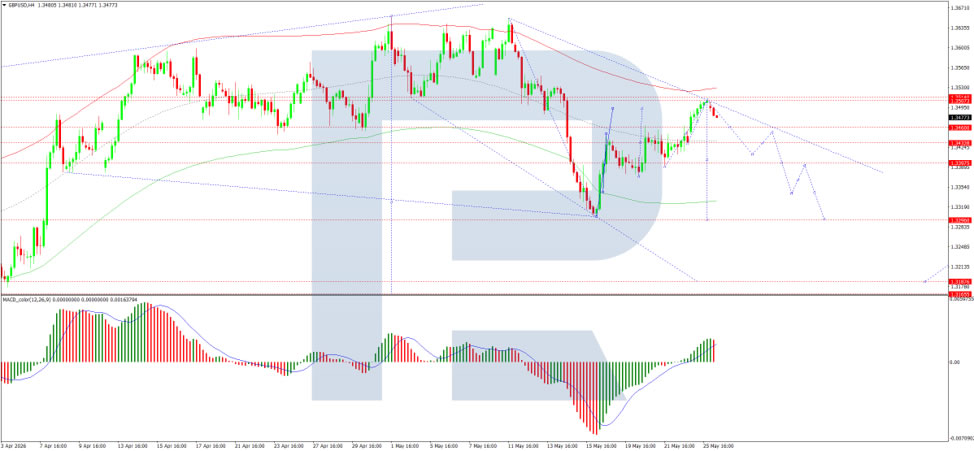
On the H4 chart, the GBP/USD pair has reached the 1.3500 level and is trading within a broad consolidation range above 1.3434. A move lower towards 1.3393 is likely in the near term. After this, the pair may consolidate, with potential for a move towards 1.3455 on the upside or a decline towards 1.3290 on the downside. The MACD indicator supports this scenario, with its signal line above zero and pointing firmly downwards, indicating weakening bullish momentum.
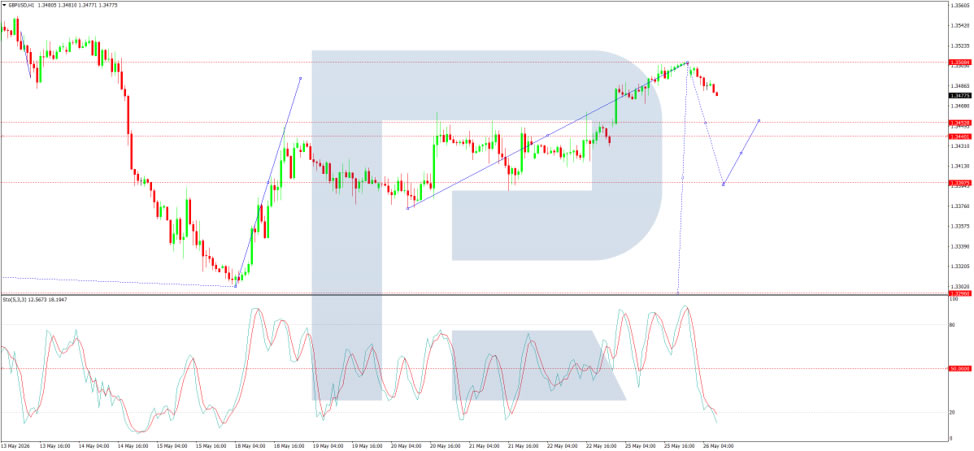
On the H1 chart, GBP/USD is trading within a compact consolidation range around 1.3494, currently extending up to 1.3500. A move lower towards 1.3393 is likely. The Stochastic oscillator confirms this scenario, with its signal line below 50 and pointing firmly downwards towards 20.
Conclusion
GBP/USD remains under pressure amid weak domestic data, deteriorating public finances, and political uncertainty, which continue to weigh on sterling. UK retail sales posted their sharpest decline in nearly a year, while the budget deficit rose to its highest post-pandemic level. Labour market conditions are also softening, with rising unemployment and weak wage growth despite accelerating inflation. Although the Middle East conflict continues to support safe-haven demand for the dollar, sterling has shown some resilience by recovering from recent political pressures. However, technical indicators point to further near-term downside towards 1.3393 and potentially 1.3290. The pound’s trajectory will likely depend on whether domestic economic concerns intensify or geopolitical developments shift the broader risk environment.