

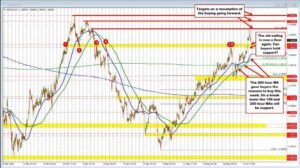
The USDCAD has been trending higher this week, supported by a combination of geopolitical tensions, widening interest-rate differentials, and a weakening Canadian economic backdrop.
From a fundamental perspective, the Canadian dollar initially came under pressure as tensions in the Middle East escalated after reports that both Iran and the U.S. violated the ceasefire, exchanging missile and drone strikes. The renewed conflict reignited risk aversion and boosted demand for the U.S. dollar as a safe-haven currency. The Canadian dollar is often vulnerable in these environments due to its close ties to global growth and commodity demand.
Adding to the uncertainty, the CUSMA trade review formally began on Tuesday when Trade Minister Dominic LeBlanc arrived in Washington. However, President Trump quickly struck a confrontational tone by posting “51st State” on Truth Social ahead of the talks, renewing concerns about future trade tensions and tariffs. The rhetoric did little to support the loonie.
A more persistent driver has been the widening interest-rate differential between Canada and the United States. The 2-year Canada-U.S. yield spread has widened by roughly 31 basis points over the last month, making U.S. assets increasingly attractive relative to Canadian assets on a carry basis.
Meanwhile, Canada’s economic data has remained soft. The economy unexpectedly contracted in the first quarter of 2026, marking a second consecutive quarterly decline on an annualized basis. At the same time, the Bank of Canada’s preferred core inflation measures slowed more than expected to their lowest levels in five years, reinforcing expectations that the Bank of Canada will leave rates unchanged at its June 10 meeting and limiting any interest-rate support for the Canadian dollar.
What are the technicals telling traders?
Technically, the pair found support on Monday near its rising 200-hour moving average, giving buyers the platform for a move higher. On Tuesday, a corrective decline retested both the 200-hour and 200-day moving averages near 1.3811, where buyers stepped in once again. The rebound gathered momentum yesterday after the price broke above a key swing area between 1.3868 and 1.3877, opening the door for further gains.
That bullish momentum carried into today’s Asian and European sessions, with the pair reaching 1.39238, its highest level since April 7. However, buyers were unable to sustain the push toward the next major resistance targets at 1.3948 and 1.3966, highs established in late March and early April.
As North American trading gets underway, broader U.S. dollar weakness is beginning to weigh on the pair. Lower Treasury yields and softer oil prices have helped spark a corrective pullback, pushing USDCAD back into negative territory on the day and toward the previously broken swing area between 1.3868 and 1.3877.
That zone is now a critical battleground. Yesterday it acted as resistance before giving way and fueling the latest leg higher. Today, traders will be watching to see whether it can serve as support. If buyers can successfully defend the area, attention will shift back toward the session high at 1.39238, followed by the March-April highs at 1.3948 and 1.3966.
If sellers regain control and break below the swing area, the focus would turn to the rising 100-hour moving average at 1.3845, the 200-hour moving average at 1.3830, and ultimately the 100-day moving average near 1.3811.