

OPEC Secretary General Haitham Al Ghais said the organisation has seen little sign of demand destruction and is holding its 2025 oil demand growth forecast at 1.2 million barrels per day.
Summary:
- OPEC is maintaining its 2025 oil demand growth estimate at 1.2 million barrels per day, with no revision signalled
- Secretary General Haitham Al Ghais said no signs of demand destruction have been registered despite widespread commentary suggesting otherwise
- He cited the Middle East conflict and Strait of Hormuz closure as examples of “one-off events” that should not deter long-term investment in the oil sector
- Al Ghais called for continued upstream investment to meet future demand requirements, warning that under-investment ahead of time leaves the market exposed
OPEC Secretary General Haitham Al Ghais has pushed back firmly against growing market scepticism over oil demand, saying the organisation has yet to see any evidence of a meaningful slowdown and is holding its forecast for consumption growth at 1.2 million barrels per day for 2025.
Speaking at the St Petersburg International Economic Forum, Al Ghais acknowledged the volume of commentary questioning oil’s demand trajectory but said the data does not support it. The Strait of Hormuz closure and the broader Middle East conflict, he argued, are one-off disruptions that should be kept in perspective rather than treated as structural signals for the sector.
Al Ghais is not alone in holding that view. Despite the unusual convergence of geopolitical pressures, elevated prices, and slowing growth in key consuming regions, several major forecasting bodies have been reluctant to revise demand estimates sharply lower. The International Energy Agency has maintained positive, if more modest, growth projections for 2025, and the US Energy Information Administration has similarly resisted cutting its consumption outlook despite acknowledging downside risks. The common thread across forecasters is that actual demand data, rather than macro conditions alone, has not yet justified a significant downgrade.
That said, the consensus is not unanimous. Some analysts and banks have flagged softer refinery margins, lower industrial throughput in China, and weaker freight demand as early indicators that consumption growth is beginning to slow, even if headline figures have not yet caught up.
For OPEC, the stakes in maintaining a constructive demand view are significant. The group has been carefully managing output increases, with several members returning barrels to the market in recent months. A credible demand outlook is essential to that strategy holding together. If consumption data begins to diverge more sharply from OPEC’s projections, pressure on the group’s cohesion will grow.
Al Ghais used the St Petersburg platform to reinforce the investment case for oil, warning that the industry must commit capital well ahead of future demand cycles. The concern is one the secretary general has raised repeatedly: that premature pessimism about oil’s long-term role risks creating the conditions for a supply crunch even as near-term sentiment turns cautious.
—
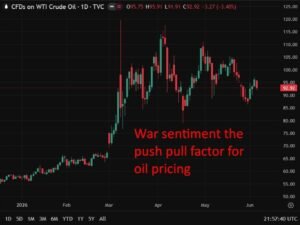
Al Ghais’s remarks offer a degree of support to oil prices at a time when geopolitical risk has been pulling in competing directions, with Hormuz closure fears pressuring supply while demand uncertainty weighs on the other side. However, OPEC’s demand optimism sits in tension with weaker economic signals out of China and Europe, and traders will continue to price the gap between official forecasts and real-time consumption data.