Every Telegram signal group has the same gallery: green screenshots, “TP hit” stickers, and a member thanking the admin. What you rarely see is the full list: every signal, with its entry, its stop, its exit, and the losing trades sitting next to the winners. Without that list, a win rate is just a claim.
This third article in our Next Move Academy series looks at the Trading Room, the platform’s signal service, and asks one question: what changes when every signal is recorded on the platform from the moment it is issued?
Disclosure: Next Move Markets and Next Move Academy are run by the same founder. Past results do not predict future results.
What the research says about chat-group trading
- Researchers who monitored more than 300 Telegram channels between 2018 and 2019 identified 412 crypto pump-and-dump events, and estimated that around 100 organised channels ran about two pumps a day, generating some $6 million of artificial trading volume a month.
- A follow-up study expanded the dataset to 10,687 pump events across 765 coins.
- FINRA (December 2025), ASIC (May 2026), the FSCA (May 2026) and Romania’s ASF (August 2025) have all warned about “investment groups” on Telegram and WhatsApp in which fake mentors share trading signals and promise returns.
- Even with honest providers, 74% to 89% of retail CFD accounts lost money in the data behind ESMA’s 2018 restrictions.
The common thread is not Telegram itself, which is just a messaging app. It is the absence of a record that the provider cannot edit after the fact.
One room, with the losses on the scoreboard
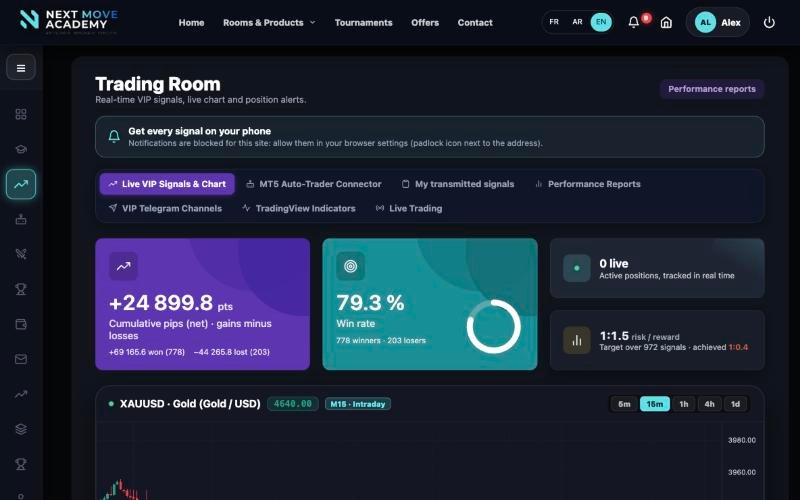
The top of the Trading Room is a scoreboard calculated from the signal history, and it includes the parts a marketing screenshot would leave out. At the time of writing, the history held 981 signals, of which 203 were losers. Pips lost are shown next to pips won. The average risk/reward is shown twice: the target of 1:1.5, and the 1:0.4 actually achieved, which is lower because many trades are closed early by the protective stop.
That second number matters. A high win rate with a small average win can still lose money for a trader who sizes positions badly. A room that shows you both lets you judge for yourself.
Every signal, drawn on the chart

Signals cover gold (XAUUSD) and Bitcoin (BTCUSD) on three styles: scalping (5 minutes), intraday (15 minutes and 1 hour) and swing. Each one is drawn on a live chart with its entry, its initial stop loss, the currently advised stop, and up to three take-profit targets. Filters let you show only the style, timeframe or asset you trade.
The timestamped step log: the record Telegram does not keep

Each signal has its own card with a timestamped step log. In the example above, a sell on BTCUSD was issued at 09:15 with its initial stop. The log then records each management rule as it fires:
- Halfway to TP1: the stop moves to lock in 20% of the target gain (at least 10 pips), so a reversal still exits in profit.
- TP1 reached: the stop moves up to secure 80% of the gain.
- TP2 reached: the stop locks 80% of the TP2 gain.
The stop only ever moves forward, never back. The card shows the net result in points, a “Copy for MT5” button with the levels, and an “I moved my SL” button so you can confirm you followed the update. Closed signals stay in the history, and old ones move to an archive rather than disappearing.
Three ways to receive the same signal
- In the platform: live tracking on the chart and the step log above.
- On Telegram: yes, the Academy uses Telegram too, as a notification channel, so the alert reaches your phone with the levels ready to copy. The difference is that the record lives on the platform, not in a chat that can be edited or deleted.
- On MetaTrader 5: the Next Move Connector places the order on your own account.
MetaTrader 5: automatic, or one click in manual mode
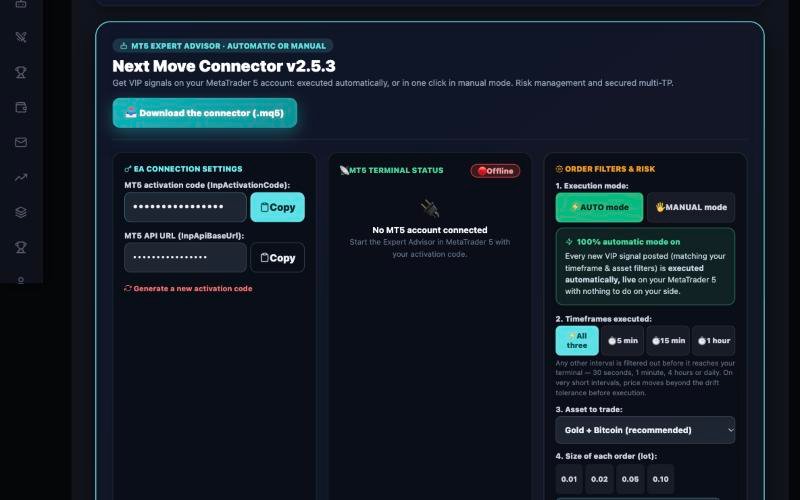
The Next Move Connector is an Expert Advisor for MetaTrader 5. You download it, compile it in MetaEditor, allow web requests to the Academy’s address, attach it to a chart and paste your personal activation code. From the connector page you then decide how it behaves:
- Execution mode: AUTO places each matching signal on your account; MANUAL only proposes it, and nothing happens until you click Execute.
- Timeframes: 5 minutes, 15 minutes, 1 hour, or all three. Other intervals are filtered out before they reach your terminal.
- Assets: gold, Bitcoin, or both.
- Lot size: a fixed lot per order, from 0.01.
- Risk preset and profit lock: careful, moderate or aggressive presets, and the same forward-only stop rules as the Trading Room.
The page also shows whether your terminal is online, your open positions and your latest closed trades, so you can check that what happened on your account matches what the room recorded.
Telegram signal group vs Trading Room: side by side
| Typical Telegram signal group | Next Move Academy Trading Room | |
|---|---|---|
| Track record | Selected screenshots | Full history: 981 signals including 203 losers at the time of writing |
| Risk/reward | Rarely stated | Target and achieved both displayed |
| Trade management | “Move SL to BE” messages, if you see them in time | Rules applied and logged with timestamps |
| Execution | Copy by hand from a message | MT5 connector, automatic or one-click manual, with your own filters |
| Editing the past | Messages can be deleted | Closed signals stay in the history or the archive |
| Where the money is | Often sent to the provider | In your own account at the broker |
The honest bottom line
No signal service can promise profits, and this one does not. What a tracked room gives you is the ability to check: every entry, every stop, every loss, and the exact moment each rule fired. Combined with the Education Room from the previous article, that is the difference between following a group and understanding a method.
See the Trading Room for yourself: create your free Next Move Academy account.
Risk warning: trading CFDs, forex and crypto assets carries a high risk of losing money rapidly due to leverage. Automated execution does not remove that risk. Figures quoted describe the platform’s signal history at the time of writing and are not a forecast or a promise of results. This article is not investment advice.
Sources: Xu & Livshits, “The Anatomy of a Cryptocurrency Pump-and-Dump Scheme”; “Pump, Dump, and then What? The Long-Term Impact of Cryptocurrency Pump-and-Dump Schemes”; ESMA, product intervention on CFDs (2018); ASF Romania warning (2025); FINRA investor alert (December 2025); ASIC and National Anti-Scam Centre warning (May 2026); FSCA warning (May 2026). Screenshots and figures: Next Move Academy Trading Room, 16 November 2026.
Keep reading
Published by the Global Research Desk under the editorial responsibility of Youssef Elhouari, Founder & Editor-in-Chief. For information and education only, not investment advice. See our editorial policy.