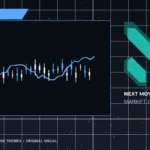
The GBP/JPY pair has come under pressure after the Bank of Japan raised its policy rate to 1.0% on 16 June. The Bank of England is following the opposite path: at its 30 April meeting, the Monetary Policy Committee (MPC) voted 8–1 to keep the base rate at 3.75%, with one member advocating an increase to 4%. The June MPC meeting, scheduled for 18 June, is expected by analysts to result in another hold, as inflation remains above the target level. The narrowing interest rate differential between the two central banks continues to build a fundamentally supportive backdrop for the yen.
Suivez Next Move Markets sur Telegram
Recevez nos alertes Forex, Or & Crypto en direct 24/7 sur notre canal officiel.
Technical Picture
On the 4-hour GBP/JPY chart, an ascending triangle structure can be observed: since 8 June, an upward-sloping support has been forming against a horizontal resistance near the red 215.60 level. On 17 June, a strong bearish candle formed on elevated volume, and price broke below the pattern as well as the current market profile. If the downward momentum continues, the next key level on the downside is 213.00, which represents the base of the pattern.
In the event of a reversal, price may find support at the lower boundary of the profile at 214.35 and the POC zone at 214.65–214.70. If the upward move resumes and buyers manage to break above the upper profile boundary at 215.20, the 215.60 resistance area would come back into focus. RSI + MAs shows readings of 35, 50, 51 — the oscillator is approaching oversold territory, while its moving averages remain in neutral conditions.
Key Takeaways
The narrowing interest rate gap between the Bank of Japan and the Bank of England is creating a fundamentally supportive environment for the yen. RSI is approaching oversold levels, although the MAs remain in neutral territory. The next directional move is likely to be driven by the Bank of England’s decision on 18 June.
Trade over 50 forex markets 24 hours a day with FXOpen. Take advantage of low commissions, deep liquidity, and spreads from 0.0 pips (additional fees may apply). Open your FXOpen account now or learn more about trading forex with FXOpen.
This article represents the opinion of the Companies operating under the FXOpen brand only. It is not to be construed as an offer, solicitation, or recommendation with respect to products and services provided by the Companies operating under the FXOpen brand, nor is it to be considered financial advice.
Editorial note: This recovered market brief has been cleaned and reclassified by Next Move Markets for educational market intelligence. It is not investment advice.
Next Move Markets desk view
For active traders, this brief should be read through the lens of global markets rather than as a standalone headline. The key question is whether the theme behind GBP/JPY: Ascending Triangle Under Pressure can influence positioning beyond the first reaction. That means watching liquidity, macro data, sentiment, positioning and cross-asset confirmation together, not in isolation.
A richer trading read comes from separating the catalyst from confirmation. The catalyst explains why markets are paying attention; confirmation comes from price action, liquidity and cross-asset behavior after the headline is digested. If those signals do not align, traders should treat the move as fragile and keep risk tighter.
What traders should watch next
- Whether price action confirms the headline after the first reaction has passed.
- How related markets respond, because isolated moves are easier to reverse.
- Any follow-up data or official comment that changes the original market assumption.
- Volatility and liquidity conditions, which should guide risk size before direction.
Risk context
This article is a market-intelligence brief, not a trade recommendation. Before acting on the theme, traders should define invalidation, position size and the time horizon of the setup. The same headline can support a short-term reaction and still fail as a multi-session trend if liquidity, policy expectations or broader sentiment move the other way.
Scenario map
The base case is that traders keep this theme on the radar while waiting for confirmation from liquidity, macro data, sentiment, positioning and cross-asset confirmation. A stronger continuation scenario requires follow-through after the first reaction, preferably with related assets moving in the same direction. A failure scenario develops if the headline is quickly absorbed, volatility fades and price returns inside the previous range.
For global markets, the most useful approach is to compare the article theme with live market behavior. If the market confirms the narrative, pullbacks can become more constructive. If the market rejects it, the headline becomes background noise rather than a trading driver.
Execution discipline
- Define the level first: traders should know where the idea is invalidated before thinking about upside or downside.
- Separate news from setup: GBP/JPY: Ascending Triangle Under Pressure may explain attention, but entry quality still depends on timing, liquidity and risk/reward.
- Watch confirmation: a clean move usually appears across related markets, not only in one isolated instrument.
- Control exposure: if volatility expands, smaller position sizing can be more professional than chasing the headline.
Next Move Markets treats this kind of brief as a starting point for preparation: identify the driver, map the scenarios, then wait for the market to prove which path is actually being priced.