


The Bank of Japan left its interest rate unchanged at 0.75% per annum, as widely expected. At the same time, it raised its inflation forecast for 2026 to 2.8%, up from 1.9% previously, while downgrading its GDP growth outlook to 0.5% from 1.0%. These revisions reflect the likely economic consequences of the ongoing Middle East conflict.
Investors are also monitoring developments surrounding Iran. Tehran has sent a new proposal to the US, but disagreements over the nuclear programme remain a key obstacle.
An additional factor is the stance of Japanese authorities. Finance Minister Satsuki Katayama reiterated her readiness to intervene in the foreign exchange market if necessary and emphasised increased coordination with the US on foreign exchange policy.
Technical Analysis
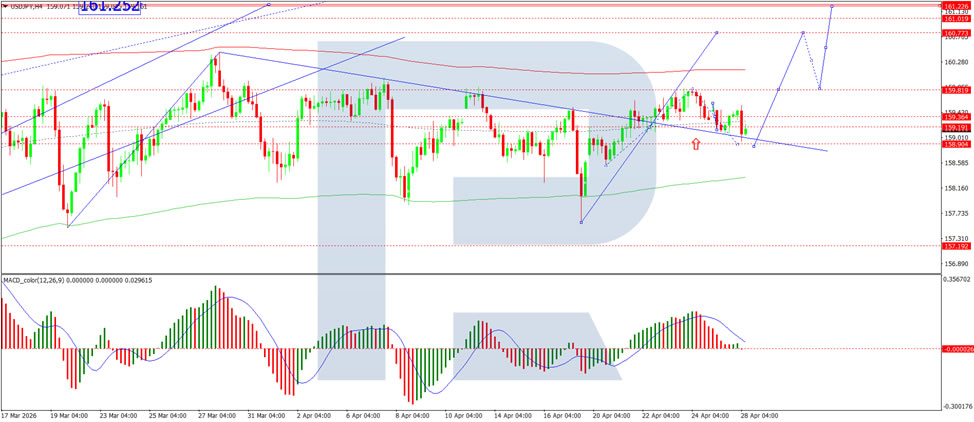
On the H4 chart, USD/JPY is trading within a consolidation range around the 159.36 level and is moving lower towards 158.90. A test of this level is likely, followed by a possible rebound towards 159.88 and potentially 160.77. Technically, this scenario is confirmed by the MACD indicator, with its signal line above zero but pointing firmly downwards, indicating the potential for further short-term downside before a recovery.
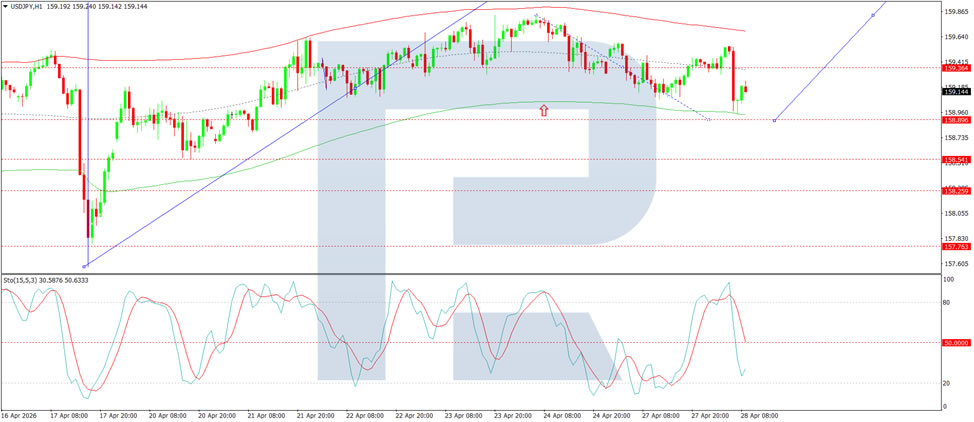
On the H1 chart, USD/JPY is developing a move lower towards 158.90. A rebound towards 159.88 may follow, with a possible extension to 160.77. The scenario is confirmed by the Stochastic oscillator, with its signal line below 50 and pointing firmly downwards towards 20, indicating that short-term downside pressure remains.
Conclusion
The yen has found some support following the Bank of Japan’s policy decision, despite the BoJ leaving rates unchanged. The key takeaway for markets was the upward revision to inflation forecasts – from 1.9% to 2.8% –driven by the Middle East conflict, alongside a downgrade to GDP growth expectations. This suggests the BoJ is acknowledging persistent price pressures while balancing weaker economic activity. Additionally, Finance Minister Katayama’s renewed commitment to currency intervention and US-Japan policy coordination has helped support the yen. Technically, USD/JPY may see further short-term downside towards 158.90 before a potential rebound. The overall direction will depend on geopolitical developments and any further signals from Japanese authorities regarding intervention.