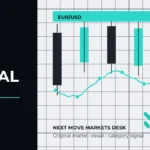
The EUR/USD pair is currently caught in a state of consolidation, effectively trapped between a significant overhead downward trendline and a critical support floor. This technical bottleneck reflects a market in a holding pattern as traders calibrate their positions in the lead-up to the next European Central Bank (ECB) policy announcement.
Beyond the immediate central bank focus, currency markets are showing heightened sensitivity to geopolitical tensions. Uncertainty surrounding impending policy decisions regarding the conflict with Iran is weighing heavily on sentiment, contributing to the current lack of clear directional momentum. As these two major catalysts converge, participants are prioritizing capital preservation, resulting in the observed rangebound activity.
Key Market Drivers
The primary driver of the current EUR/USD landscape is the anticipation of the ECB’s upcoming policy session. With investors parsing recent economic data for hints on the path of interest rates, the euro is struggling to find a breakout trigger. The central bank’s stance on inflation and growth will be instrumental in determining whether the pair can overcome its technical resistance.
Concurrently, the macro environment is heavily influenced by geopolitical risk. The potential for a fundamental shift in U.S. executive policy toward Iran has introduced a premium for safety. In this context, the DXY and major currency pairs are being buffeted by shifting expectations between a diplomatic ceasefire and the prospect of a wider conflict. This creates a liquidity environment where volatility spikes are possible, even while the pair remains locked in a short-term trading range.
Trader Takeaways
- Monitor the reaction to the ECB announcement as the primary catalyst for a potential break from current technical constraints.
- Maintain a high degree of awareness regarding geopolitical updates, as headline risk related to the U.S. and Iran could trigger sharp, unpredictable moves in risk-sensitive assets.
- Respect the defined range, as momentum trading often fails within narrow consolidation zones.
- Ensure stop-loss placement accounts for the volatility that typically accompanies major central bank press conferences.
- Recognize that while the technical setup suggests a breakout is pending, artificial range compression can lead to false signals prior to a confirmed move.
Levels and Signals to Watch
The current price action is defined by a tightening of ranges. The downward-sloping trendline acts as the immediate ceiling, preventing upside follow-through, while the base support level serves as the final defense against a deeper correction. Traders should watch for a definitive candle close outside of these bounds to confirm a breakout. Increased volume on such a move would be necessary to validate a shift in momentum, while low-volume spikes are more likely to be treated as liquidity hunts. Effective risk management at these junctures remains vital, as the combination of policy uncertainty and headline risk increases the probability of erratic price swings.
Cross-Asset Context
The behavior of the EUR/USD is currently inseparable from broader cross-asset dynamics. The U.S. Dollar Index (DXY) serves as the anchor; any sustained weakness or strength in the dollar will directly dictate the pair’s ability to breach its technical barriers. Simultaneously, commodities such as oil remain a critical monitor, as energy price volatility is a direct byproduct of the ongoing geopolitical standoff. Shifts in safe-haven demand—often manifested in gold prices—can also provide clues to the market’s underlying appetite for risk, which ultimately filters down into currency market flows.
Risk Context
Traders must exercise caution against overconfidence regarding the outcome of both the ECB policy meeting and political decision-making. The current market is prone to knee-jerk reactions; therefore, the assumption that a specific “fundamental” outcome will guarantee a sustained directional trend is dangerous. Unexpected shifts in rhetoric from central bankers or sudden changes in diplomatic status can invalidate existing technical patterns in an instant. Maintaining a neutral posture until clear, data-driven conviction emerges is a prudent strategy in an environment defined by high-impact binary outcomes.
Editorial note: This article is market intelligence for educational purposes and is not investment advice.
Next Move Markets desk view
For active traders, this brief should be read through the lens of currency markets rather than as a standalone headline. The key question is whether the theme behind EUR/USD Consolidates as Markets Anticipate ECB Rate Outlook and Iran News can influence positioning beyond the first reaction. That means watching central-bank expectations, yield differentials, dollar momentum and risk appetite together, not in isolation.
A richer trading read comes from separating the catalyst from confirmation. The catalyst explains why markets are paying attention; confirmation comes from price action, liquidity and cross-asset behavior after the headline is digested. If those signals do not align, traders should treat the move as fragile and keep risk tighter.
What traders should watch next
- Whether the move is confirmed by the U.S. dollar index and short-term rate expectations.
- How London and New York liquidity react once the initial headline risk is absorbed.
- Whether price action respects the latest support and resistance zones instead of fading immediately.
- Any follow-up comments from central-bank officials or data releases that change the rate path.
Risk context
This article is a market-intelligence brief, not a trade recommendation. Before acting on the theme, traders should define invalidation, position size and the time horizon of the setup. The same headline can support a short-term reaction and still fail as a multi-session trend if liquidity, policy expectations or broader sentiment move the other way.
Scenario map
The base case is that traders keep this theme on the radar while waiting for confirmation from central-bank expectations, yield differentials, dollar momentum and risk appetite. A stronger continuation scenario requires follow-through after the first reaction, preferably with related assets moving in the same direction. A failure scenario develops if the headline is quickly absorbed, volatility fades and price returns inside the previous range.
For currency markets, the most useful approach is to compare the article theme with live market behavior. If the market confirms the narrative, pullbacks can become more constructive. If the market rejects it, the headline becomes background noise rather than a trading driver.
Execution discipline
- Define the level first: traders should know where the idea is invalidated before thinking about upside or downside.
- Separate news from setup: EUR/USD Consolidates as Markets Anticipate ECB Rate Outlook and Iran News may explain attention, but entry quality still depends on timing, liquidity and risk/reward.
- Watch confirmation: a clean move usually appears across related markets, not only in one isolated instrument.
- Control exposure: if volatility expands, smaller position sizing can be more professional than chasing the headline.
Next Move Markets treats this kind of brief as a starting point for preparation: identify the driver, map the scenarios, then wait for the market to prove which path is actually being priced.