

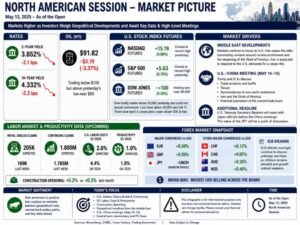
As the North American session gets underway, Treasury yields are moving modestly lower, with the 2-year yield down -2.1 basis points at 3.51% and the 10-year yield lower by -2.2 basis points at 4.332%. Oil prices are also under pressure, falling $3.19 or -3.37% to $91.82. Even with today’s decline, crude remains above yesterday’s lows near $89, while continuing to trade below the key $100 level.
U.S. equity futures are pointing modestly higher ahead of the open. NASDAQ futures are up 15 points, while S&P futures are higher by roughly 6 points. Both indices closed at record levels yesterday. Dow futures are also higher, implying an opening near the psychologically important 50,000 level. Yesterday, the Dow briefly traded above 50,000 but failed to sustain momentum into the close. The last confirmed close above that milestone came back on February 11, during a stretch where the index posted four consecutive closes above 50,000.
Fundamentally, markets continue to trade around developments in the Middle East. Reports yesterday suggested progress toward a one-page memorandum aimed at establishing a cease-fire framework between the U.S. and Iran, helping fuel the strong risk-on move seen across markets. However, major uncertainties remain surrounding uranium enrichment, the future reopening of the Strait of Hormuz, and the broader geopolitical framework needed for a lasting agreement. Until there is greater clarity on those issues, concerns over economic disruptions, energy flows, and inflation pressures are likely to remain elevated as President Trump and Israeli Prime Minister Netanyahu continue to emphasize preventing Iran from maintaining nuclear capabilities. Iran is expected to formally respond to the latest U.S. cease-fire demands soon.
Separately, President Trump and China’s Xi Jinping are scheduled to meet on May 14–15. The talks are expected to focus on:
- Trade tensions and tariffs
- Taiwan
- Semiconductor and rare-earth restrictions
- Iran and the Strait of Hormuz
- Potential extensions of the current trade truce
Ahead of the China meetings, U.S. Treasury Secretary Scott Bessent is expected to meet with Japanese officials, with the value of the JPY likely to be a key topic of discussion.
In the foreign exchange market this morning, the broader bias remains tilted toward modest U.S. dollar selling. EURUSD and GBPUSD are both higher by around 0.20%, while USDJPY is little changed in narrow trading. Overnight, ECB officials continued to discuss the possibility of additional rate hikes as inflation pressures remain elevated and growth conditions continue to deteriorate.
Elsewhere, the broader FX market is also leaning against the dollar:
- CHF +0.12%
- CAD +0.05%
- AUD +0.30%
- NZD +0.40%
In the video above, I take a look at the three major currency pairs — EURUSD, USDJPY, and GBPUSD — from a technical perspective, outlining the bias, the key risk-defining levels, and the upside and downside targets in play.