

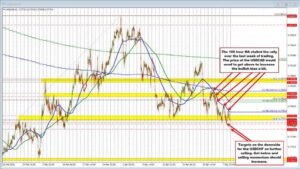
The USDCHF continues to lean against its 100-hour moving average as a key resistance barometer. Corrective rallies last week stalled against that moving average on Tuesday, Wednesday, Thursday, and Friday — and today’s rally attempt once again failed near the same level. If buyers are to take back more control, the pair needs to break above and stay above the 100-hour MA at 0.77913. Until that happens, the buyers are not winning the technical battle.
On the downside, the pair has moved back below a key swing area along with the 61.8% retracement of the move up from the January 2026 low, between 0.7771 and 0.7782. Staying below that zone keeps the sellers firmly in control and shifts focus toward last week’s low at 0.7760. Below that, traders will target the March low at 0.77468. A move beneath those levels would increase the bearish bias and open the door for further downside momentum.
For the USDCAD, the pair moved higher on Friday but stalled near a major resistance cluster. The rally tested the 38.2% retracement of the decline from the early-April high at 1.37085, while also reaching the lower end of a swing area between 1.37089 and 1.37149. Adding to the resistance, the falling 200-day moving average comes in near 1.3719. Sellers leaned against that confluence area on Friday, helping to push the pair back lower, with downside momentum extending into today’s session.
The next downside target comes in at the rising 100-hour moving average near 1.3642. Below that, traders will look toward the 200-hour moving average at 1.36314, followed by a swing area between 1.36199 and 1.3630. Additional downside support targets come in between 1.35934 and 1.3600. As long as the price remains below the key resistance cluster near 1.3710–1.3720, sellers maintain the near-term technical advantage.